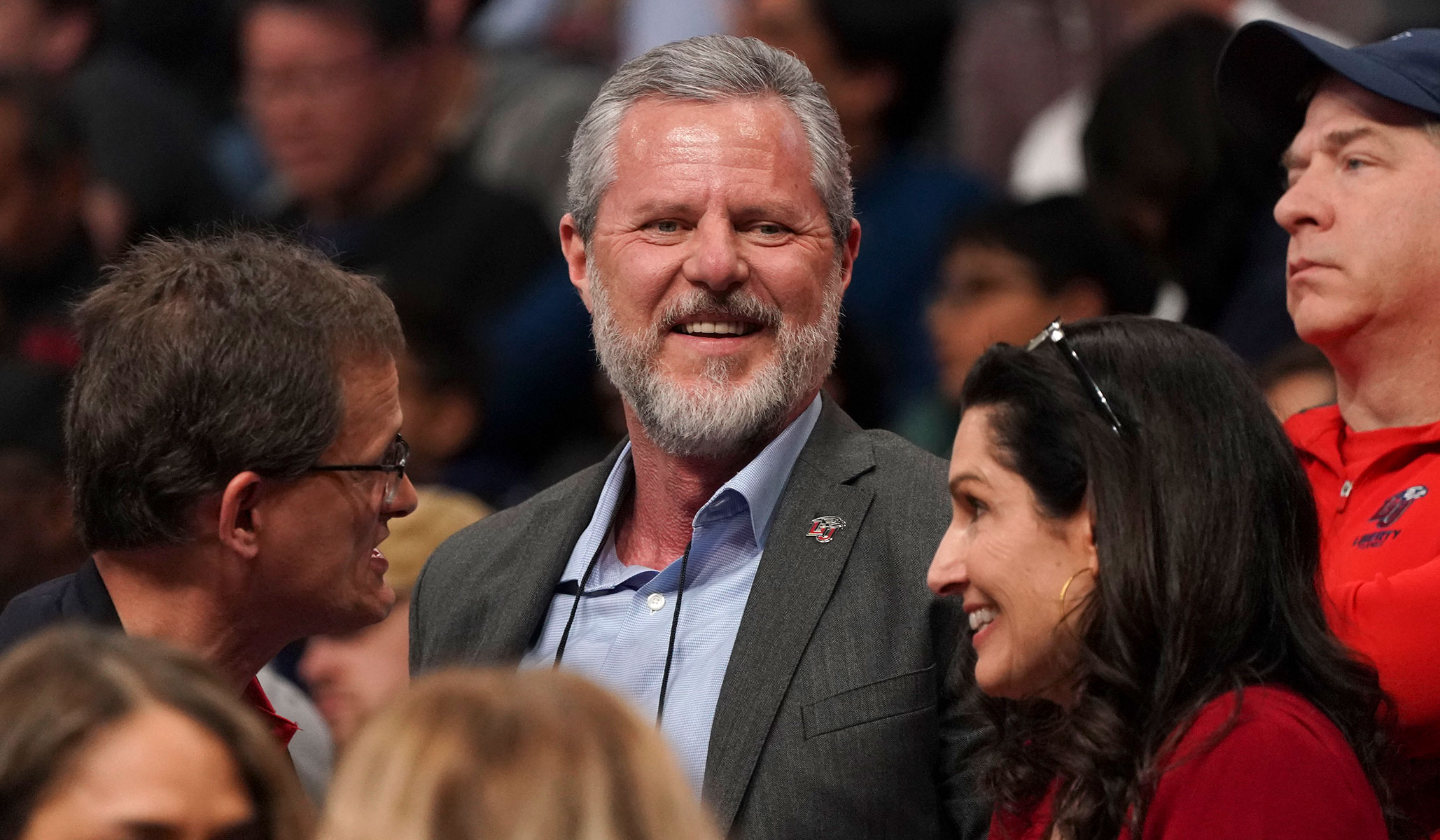
One of the country’s most infamous Evangelicals got a splashy profile story in Vanity Fair last week — but Jerry Fallwell Jr. wouldn’t claim the label “Evangelical” or even “religious” at this point. After he was publicly self-destructing and forced into resignation last year from his position as president of Liberty University, Vanity Fair has unearthed the drama that led to his downfall — complete with exhaustive details about his wife Becki’s “pool boy” affair and surprising news about Falwell’s reluctance to lead Liberty after his father died in 2007. What we can glean is this: Fallwell Jr. is not the religious man he’s been playing the part of — and he never was. “Because of my last name, people think I’m a religious person,” he said. “But I’m not. My goal was to make them realize I’m not my dad.” Though the elder Falwell, who founded Liberty in 1971, also had a controversial reputation (he was pro-segregation in the 1960s, for example), he was known as a deeply religious man who led the uprising of the religious Right. Falwell Jr. may not have the same love for the Church as his father did, but he does appear to have a similar faith in Republican politics. The Falwell Jr. persona portrayed in the piece is cast as what I call a “Donald Trump Christian” — one who masquerades in religion for political gain. As one revealing statistic from the 2016 presidential primaries showed, Evangelicals most likely to vote for Trump were least likely to attend church regularly. That’s not to say that Trump supporters who are Christian are faking their faith. After all, the majority of Evangelicals did support him in the general election (churchgoing or not), for valuable reasons such as Supreme Court nominations and economic and pro-life policies. In light of the standout demographics from the primaries, however, Falwell’s deep unity with Trump begins to make sense. And, perhaps, he saw a bit of himself in Trump’s superficial appeals to religious voters as the general election neared. Fallwell Jr. stopped attending church after college. Though his famous father is the other public face of the family, it was Falwell Jr.’s “hardline Baptist” mother whom he rebelled against. He said he cast off the “Evangelical” label in college, eager to move on from the strict, religious ways of home. Today, he has only negative things to say about “organized religion,” “church,” and “evangelical rules” — though he does still deem himself “a strong believer in Christ.” “Organized religion says you have to earn your way to heaven,” he says in the piece. “What Jesus said was, ‘You just have to believe.’” It’s a great pull quote, but it tells you a lot about his fundamentalist upbringing. Works-based salvation — touted most often in fundamentalist circles — isn’t the common refrain of mainstream Evangelical Christianity today. The comment makes him appear out of touch with even the university he spent years running. Ironically, he laments the “religious elite” who have “this idea that somehow their sins aren’t as bad as everyone else’s.” But his unapologetic response to his own scandals put him firmly in that same camp. When he became president of Liberty in 2007, he did not welcome his immediate move into the Christian spotlight. Was this the beginning of an extended downward spiral? “He had successfully compartmentalized his public and private identities for most of his life,” the article reads. “Why stop now?” He became a public face for Evangelical Christianity, but it wasn’t who he really was. Regardless of his personal beliefs, Trump’s alliance with Evangelical Christians was a natural opportunity for Falwell to step in and utilize his influence. He spent ample time at the White House during Trump’s term and was unapologetic about his support, despite contrary opinions among many students at Liberty — some of them, with open letters and petitions, revolted against Falwell’s Trumpism. In the article we learn that Rush Limbaugh was Falwell’s idol. And that his personal life choices were more aligned with Trump’s and Limbaugh’s (drinking, racy photos) than those of, say, Ted Cruz or Marco Rubio — two Evangelical primary favorites. While many Christians reluctantly voted for Trump in the general to preserve policies they believed in, Falwell enthusiastically endorsed him in early 2016 and urged other conservative Christians to do the same. The campaign to woo Evangelical voters worked, and Falwell played a big role in it, but by Trump’s 2020 loss, the excitement was gone. After racially insensitive and sexually questionable Instagram posts appeared on Falwell’s account last year, he seemed to be trying to get fired. His wife’s affair becoming public was the last straw. Basically, he was pointing to the church and screaming, “This is not who I am!” Regardless of his insistence that he’s not “Evangelical” or “religious,” the media will continue to label him and others like him as representatives of Christianity. But don’t fall for it. It’s true: No one knows the heart of a man. Going to church doesn’t make you a Christian. Bad behavior doesn’t mean you’re not a Christian. I’m not saying that Trump or Falwell are not Christians in their hearts. But Falwell is telling us who he is, and we should believe him.
The Real Jerry Falwell Jr. Has Stood Up

 JackNot,😀, (Big,Ne'ws),