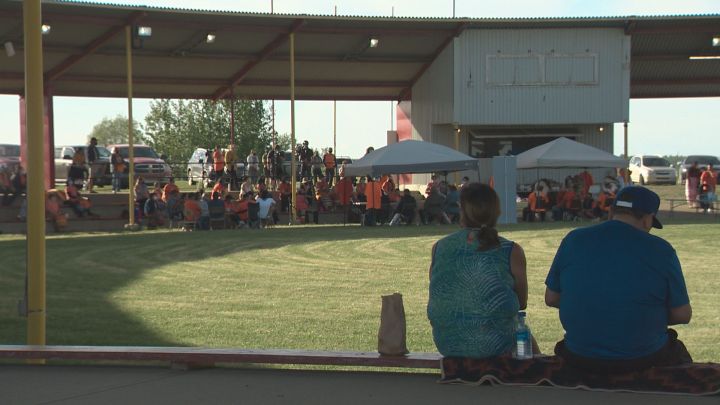
Dozens of First Nations members south of Edmonton came together Monday night to pay their respects to the 215 children whose remains were discovered at a residential school site in the Kamloops, B.C. area last week. Randy Ermineskin, the chief of Ermineskin Cree Nation and a residential school survivor himself, said the past few days have been a whirlwind. “These kids have been crying out through their graves, ‘Come and find us. We are here,’” he said. “Somehow, through prayer, they were found… (so they could) make a statement to all of the world that there’s some wrongdoing that needs to be corrected.” Monday’s vigil was held at Maskwacis’ Bear Park, about 100 kilometres south of Edmonton. Members of the Ermineskin Cree Nation, Montana First Nation, Samson Cree Nation and Louis Bull Tribe were in attendance as several people spoke to the crowd. A poem was read and a song was performed in honour of those who died. Many in attendance on Monday wore orange shirts. Orange Shirt Day began several years ago as a way of remembering the victims of Canada’s residential school system. The event was inspired by the story of a residential school student who had an orange shirt taken from her. READ MORE: Orange Shirt Day sees Edmontonians be part of reconciliation, remembrance Last week, the Tk’emlúps te Secwépemc band confirmed the children’s remains had been found in B.C. through the use of penetrating radar. “My heart sank,” Ermineskin said. “I went to residential school. “Society had tried to say that it never happened… There’s a term… your sins will come and find you out. I think we’re seeing that.” From the 1870s until 1996, over 150,000 First Nations, Métis, and Inuit children were placed in dozens of residential schools across the country, often despite their parents’ opposition. In many cases, they were then forbidden from speaking their language or maintaining their culture. Many students were subjected to abuse of all kinds, and the schools saw high mortality rates. In 2015, the Truth and Reconciliation Commission said the church-run and government-funded schools amounted to nothing short of a “cultural genocide.” READ MORE: Canada’s aboriginal residential school system was ‘cultural genocide,’ report says A national student death register is being maintained by the National Centre for Truth and Reconciliation and currently includes 4,118 children. Wilton Littlechild, 77, is a lawyer and former Grand Chief of the Confederacy of Treaty Six First Nations as well as a former MP. He is also a residential school survivor and spoke at Monday’s event. He told Global News that he had mixed emotions upon learning of the discovery of the children’s remains last week. “In a way, it’s two kinds of feelings: one of pain because there’s been denial about these stories and all of a sudden, we discover 215 (bodies),” he said. “And you can only feel the pain of the parents and the children. “At the same time, you have joy — joy that they were found… In our tradition… we do certain ceremonies, and the toughest one is when you lose a child. “There’s all these families that didn’t know where their child was… They couldn’t do a feast, a wake, a funeral… It’s very painful from that perspective, but yet, it’s a happy moment in a way for the children to be found… so the parents were able to find out where their child was.” READ MORE: Experts say technology could find more residential school graves as Alberta survivors share grief Bewildered by the cruelty Littlechild said he spent 14 years in residential schools, including one nearby. He said he was taken away from his home at the age of six. “One of the pains is that while others could go home… I couldn’t,” he said, adding that he tried to run away from the school several times without success. Littlechild said he was bewildered by some of the cruelty he endured. “I wasn’t allowed to go to the funeral (of my grandparents) and the graveyard was right behind the school,” he recounted. “You wonder why, why would they do that? That’s the way it was.” Littlechild said he believes his passion for sports helped him survive the schools and the aftermath. He said he would sneak away during movie nights to go skating or to run. “I would run… trying to get away from the abuse… to forget it somehow… and most times, it was to cry,” he said. “Sports saved my life… I always wonder, would I even be alive today, the way I was treated? Some of my schoolmates, how they died — some by suicide, some by addictions… I’m blessed to have found sports to run to.” Ermineskin said he knows the trauma of residential schools was too much for some. “Our residential school is just to the south of us, about a half-hour from here,” he said, noting his brother was a student there. “I lost my brother in 1969 (to suicide). “He always used to tell me… ‘We’re going to get away from all this, and we’ll make it a better life…’ But he never fulfilled it.” Ermineskin said he thought it was good that the community was coming together on Monday but acknowledged it would be a very difficult night. “It’s not going to take the pain away immediately,” he said. ‘(Last week’s discovery) opened some wounds again. We’re not trained to close those wounds. “We have to come together… to remember, to think about a way forward that we can all heal somehow.” Ermineskin noted that he believes more needs to be done to educate people about what happened, especially younger generations. He commended Gord Downie, the late singer for the Tragically Hip, for work he did near the end of his life to bring awareness to the story of Chanie Wenjac, a young boy who died trying to escape a residential school in the 1960s. “There was a connection made there through his documentary,” Ermineskin said. “It’s important for society to recognize… something did happen. “Our youth need to understand — the public needs to understand — about the residential schools and how it affected First Nations… The genocidal effects.” Survivors of the residential school system can get support through Canada’s Indian Residential Schools Resolution Health Support Program 24-7 crisis line by calling 1-866-925-4419. View photos below: #gallery-7909945-1 { margin: auto; } #gallery-7909945-1 .gallery-item { float: left; margin-top: 10px; text-align: center; width: 33%; } #gallery-7909945-1 img { border: 2px solid #cfcfcf; } #gallery-7909945-1 .gallery-caption { margin-left: 0; } /* see gallery_shortcode() in wp-includes/media.php */ Dozens of members of several First Nations south of Edmonton came together in Maskwacis on Monday night to pay their respects to the 215 children whose remains were discovered at a residential school site in the Kamloops, B.C. area last week. Dozens of members of several First Nations south of Edmonton came together in Maskwacis on Monday night to pay their respects to the 215 children whose remains were discovered at a residential school site in the Kamloops, B.C. area last week. Dozens of members of several First Nations south of Edmonton came together in Maskwacis on Monday night to pay their respects to the 215 children whose remains were discovered at a residential school site in the Kamloops, B.C. area last week. Dozens of members of several First Nations south of Edmonton came together in Maskwacis on Monday night to pay their respects to the 215 children whose remains were discovered at a residential school site in the Kamloops, B.C. area last week.
Deaths of children found buried by B.C. residential school mourned at Maskwacis vigil

 JackNot,😀, (Big,Ne'ws),